Watching Paprika for the first time at a Japanese Film Festival when I was eight, I remember being baffled by the film's many elements of fantasy. Following an absurd scenario where a dream monitoring machine is stolen and exploited, the film shows the chaos that ensues as dreams leak into reality. It was disturbing, confusing, eerie, yet intriguing, and left me pondering the films for days after I walked out of the theater. Now, with further analysis and a closer look, Satoshi Kon's techniques to evoking this reaction from the typical movie goer become more evident.
The title scene of the film establishes Paprika as Dr.Chiba's alter ego, and reveals her fluid essence. As she rides her motorcycle, she projects herself onto the vehicles and objects around her, and then jumps back and forth between different mediums and realms like billboards and computer monitors. When the sun begins to rise, Paprika returns to the road, and, in a match cut, transforms into Dr.Chiba. This launches the film's major concept of two existing worlds in which the characters live.
To blur the line between dreams and waking life, Kon heavily relies on match cuts, which are often confusing to audiences. The film begins with a sequence linked together by disorienting graphic cuts, and disturbs the viewer with absurd scenes that Detective Konakawa finds himself in. It is only when he wakes up that the audience is explicitly told that what it was just shown was a dream. But as the film goes on, the dreams become less distinguishable from reality. When Dr.Chiba investigates the home of a missing colleague, she follows a hidden passage into an empty amusement park, where she spots an eerie "Ningyo" doll staring at her. Wanting to approach it, Chiba hops a fence, and in mid-air, the park vanishes and she finds herself hopping over the apartment's balcony fence instead, with her partner grabbing her at the last instance before she plummets to her death. Experiencing this, the audience is directly taken into the environment of the film through the confusion and paranoia that the careful juxtaposition of dreams and reality evokes.
Satoshi Kon skillfully presents contrasting ideas and images in his animation to place his viewers in the shoes of Paprika's characters (whether they like it or not). By the end of the film, themes from the dream world begin to all merge with reality, and such contrast -- sometimes drawn within the same frame -- grounds the viewers in the world of the film.
Saturday, April 2, 2016

Sunday, March 27, 2016
Why is it Called Primer Again? [Primer, Carruth, 2004)
In the Guardian's words, Primer is a "giant achievement" because it tells you that a time machine has been invented and you as the audience do not laugh out aloud. Perhaps it's the low-budge-high-authenticity, or the accurately cautious protagonists, or the sheer complexity of plot - something in Primer makes us take it seriously and attempt to be the intelligent viewers it challenges us to be.
The initial minutes of the film is challenging. On first pass, it's easy to tune out to the technical jargon, complete with incomplete sentences, the inventors exchange around the dinner table (while their spouse cleans in the background). It doesn't get "better" when they crowd around a whiteboard/poster and search between magnetism and temperature (I'm no expert, but the two concepts I don't think are connected in conventional physics). Primer asks a lot of the audience if it expects us to attempt to follow the scenes; after-all, in the age of commercial cinema we've been taught that every line uttered has a purpose in plot development or relationship dramatization. Primer's dialogue, however, stays true to the search for content/direction so many of our deliberations are. That discrepancy may be jarring at first - "what was that supposed to mean????" - but that extra effort surprisingly makes us more engaged. In a sense, like this blog post, Primer's dialogue are essays being written that are hoping to find a thesis by the conclusion, and the reader, albeit frustrated, is curious how it would all come together (I have no clue).
When Abe and Aaron "discover" the time travel machine, they proceed with such cautious steps that the audience too becomes sold on the concept. It is convenient plot structuring that Abe has to go through the process of convincing Aaron. By the time Abe disclaims that (paraphrased) "what I'm going to show you is not a prank", the movie is almost speaking to audience: "look, I know timetravel is ridiculous, but this isn't one of those films". Because of how confused the characters are - "that's how cell phones work right?" - we are willing to lend stakes to their conflict. The discovery didn't come in a string of blatantly coincidental montage; it came out of nowhere, and suddenly figuring out how to react is something both the audience and characters are doing. And that cautious confusion extends to the entire plot. From Granger to March Madness, we are not spoon-fed the story because the characters themselves have no idea what the arc is like.
By the time we get to the rapid motions of the third act, little on the fly makes sense. Primer has lost our comprehension, but interestingly, not our attention. It is evoking in us an intellectual curiosity mainstream cinema has long thought unnecessary. It reminds us that, gosh, it's a lot of fun trying to figure something out. Films like Primer (and others, not just those logically compelling, but also philosophically, socially, formally, and emotionally churning) and those of Marvel and Hollywood slapstick are kind of locked in an ideological struggle about the capacity of the viewer. Like elite socialists and capitalists, the fight is about what the "people" truly wants. Mainstream Hollywood has cast its vote behind entertainment and parables, a duo acknowledgement between the people's sometimes unenlightened desires and the responsibility of cinema to lead and shine light. Primer asserts that critical thinking and moral deliberation is something the audience already possesses, so now let's them working.
[Note to self: Yes pretty locations, but watch for location sound situation]
(I'm trying to get better at writing premises and such, so here's an attempt:)
[PRIMER: Two stock-broker-slash-part-time-inventor accidentally creates a time machine, and devise a way to use it to travel back in time and benefit their stock trade. However, one of the inventors grows increasingly concerned with the recklessness the other uses the machine, and when they discover a coworker had unknowingly accessed it, decides to travel back and stop the machine's invention. After a series of exchange during which the two inventors try "out-travel" one another, they break apart, with one staying to ensure the machine's never invented, and the other, leaving to exploit it elsewhere far away.]
Tuesday, March 22, 2016
Prime time struggles (Primer)
When Primer is broken down to its very core, the story is centered around a moral struggle. Aaron and Abe have become gods. They are capable of amassing an infinite wealth, contorting actions and discussions, and whatever else they enable themselves to do through time travel. It doesn't take long for the characters to realize that maybe everything they ever wanted is not so great after all. A moral dilemma is not uncommon in films. A moral dilemma of this caliber and relevance however, is very interesting. When the first atom bomb was built, the nuclear physicists behind it were excited to research the splitting of an atom but less excited about building a bomb. They did, however, build the bomb. All of them knew there was a potential that it would be used but none of them wanted it to come to that. Of course, when it did come to that, people such as Oppenheimer did not handle it too well. This realization came too late of course and the world was set for a nuclear arms race.
Something similar can be observed in Primer. The main characters, Aaron and Abe, seem carefree at first when they realize they have discovered time travel. They only see the positives and are quick to abuse the positives. It seems that only Abe is interested in precautions. The precautions don't matter and as most of the films close up shots show, the characters are constantly processing the actions of the future, past, and present simultaneously. Perhaps the early warning signs throughout the film could have stopped some of the negative aspects of time travel from arriving.
I'm not sure if the director, Shane Carruth is sending a message about technology itself. The film does seem to point in that direction however, and as we clearly see, often the technology moves past its creators and forces them into a mad chase over control. The message is fortified by the fact that the film is set in a timeless space. We don't know when the events take place on the timeline of the world. That doesn't seem to be the point. The point seems to be to watch out and take care to close all paths behind oneself when cornering a technological advance capable of literally bending time into one. Primer doesn't ignore this issue and clearly lays out the positives and negatives, the weight of which seems to be up to the viewer.
Primer and Antigravity: The Bittersweet Accident of Time Travel
Okay so here's the deal: there are a million fan-made diagrams on the internet concerning the timeline of Primer itself, and some of them look pretty much the same. I've definitely noticed the pattern to which most fans of Primer agree that Abe and Aaron have been traveling in some sort of continuous loop. It's like a giant loop of life.
Now how exactly does this work? The film drops a lot of dialogue that physics nerds and engineers would probably appreciate, as they talk about the the reduction of mass through means of electromagnets, to which Abe and Aaron use a "weeble-wobble" to test their experiment. However, as you already know, they create a time machine, or a box that is capable of time travel.
But how exactly does that mistake pop out of thin air? Well, let's look at how exactly this works; when the electromagnets reduce the mass of the object itself, it travels in this continuum where the the mass decreases, and then increases in some sort of pattern. When it turns off, the weeble-wobble returns to its mass that it started in, and then when the contraption turns on, it reduces the mass in some sort of pattern that goes back and forth depending on the mass before it. The way that this is executed is that the weeble-wobble can leave the apparatus in the present, but the mass will always stay the same, but that depends on whether or not the contraption is on.
How does this work mathematically? I took the time to google "antigravity" in physics, for which the purpose of it is to reduce the mass of an object through means of rotating magnetic fields. The speed of the rotation is factored into the current of the magnetic field, measured in amps. The resistor of each rotation cuff is set to a certain Ohm per meter so that it reaches a certain voltage in order to reduce the mass. The connection between voltage and mass is suggested through the Law of Conservation of Energy, where the amount of work is factored by the net force of the object along with the amount of distance. This "x" amount of work is divided by the elementary charge in order to get the voltage of the magnets and the magnetic field.
Now how exactly does this work? The film drops a lot of dialogue that physics nerds and engineers would probably appreciate, as they talk about the the reduction of mass through means of electromagnets, to which Abe and Aaron use a "weeble-wobble" to test their experiment. However, as you already know, they create a time machine, or a box that is capable of time travel.
But how exactly does that mistake pop out of thin air? Well, let's look at how exactly this works; when the electromagnets reduce the mass of the object itself, it travels in this continuum where the the mass decreases, and then increases in some sort of pattern. When it turns off, the weeble-wobble returns to its mass that it started in, and then when the contraption turns on, it reduces the mass in some sort of pattern that goes back and forth depending on the mass before it. The way that this is executed is that the weeble-wobble can leave the apparatus in the present, but the mass will always stay the same, but that depends on whether or not the contraption is on.
How does this work mathematically? I took the time to google "antigravity" in physics, for which the purpose of it is to reduce the mass of an object through means of rotating magnetic fields. The speed of the rotation is factored into the current of the magnetic field, measured in amps. The resistor of each rotation cuff is set to a certain Ohm per meter so that it reaches a certain voltage in order to reduce the mass. The connection between voltage and mass is suggested through the Law of Conservation of Energy, where the amount of work is factored by the net force of the object along with the amount of distance. This "x" amount of work is divided by the elementary charge in order to get the voltage of the magnets and the magnetic field.
Saturday, March 19, 2016
Pretending To Understand Primer
With it's not white balanced "authentic" look and occasionally out of focus shots, Primer definitely looks like a movie made for $4,000. At times it sounds like it was made for even less. The "searching for a cat by a fountain in a city miles from where either character lives" scene walks the line of ridiculous, non-sequitur detail previously tread by The Room's "You're my favorite customer," scene, and Birdemic's "solar panel installation because why?" scene. I guess what sets the film apart for some is it's engaging dialogue about time travel which I found so confusing that I gave up trying to fallow it about fifteen minutes into the film.
This is why, with it's grainy look and unapologetic geekiness, Primer is a true twee film.
The film embraces it's nerdiness, never talking down to it's audience or trying to portray it's heros as hyper-masculine or tough. Despite their sophisticated dialogue, the main characters Abe and Aaron, have a twee, childishness about them. Director Shane Carruth says in his commentary that he wanted to depict them as kids screwing around in a clubhouse rather than mature inventor's pondering the secrets of the universe.
The film embraces it's rough edges as signs of authenticity. Carruth also noted in his director's commentary that he chose the slightly un-balanced, yellowish color on purpose for it's rawness. If you want to see how DIY this thing really was, just get a look at it's wiki page.


While this wasn't my favorite film we've watched in class, I can appreciate the work and DIY spirit put forward by Director/ Producer/ Writer/ Actor/ Musician/ Editor Shane Carruth.
This is why, with it's grainy look and unapologetic geekiness, Primer is a true twee film.
The film embraces it's nerdiness, never talking down to it's audience or trying to portray it's heros as hyper-masculine or tough. Despite their sophisticated dialogue, the main characters Abe and Aaron, have a twee, childishness about them. Director Shane Carruth says in his commentary that he wanted to depict them as kids screwing around in a clubhouse rather than mature inventor's pondering the secrets of the universe.
The film embraces it's rough edges as signs of authenticity. Carruth also noted in his director's commentary that he chose the slightly un-balanced, yellowish color on purpose for it's rawness. If you want to see how DIY this thing really was, just get a look at it's wiki page.
While this wasn't my favorite film we've watched in class, I can appreciate the work and DIY spirit put forward by Director/ Producer/ Writer/ Actor/ Musician/ Editor Shane Carruth.
Thursday, March 10, 2016
Twee bit of time in Glasgow (God Help the Girl)
Stuart Murdoch is a musician at heart. Even then, in interviews he exclaims how he never intended to be a musician in the first place. Well, it seems that he has also become a director whether he wanted to become one or not. Murdoch's first full length feature film, God Help the Girl is a celebration of all things twee. The movie was based off of an album by the same name and the songs from that album created the storyline of a "lazy summer in Glasgow'' as the film's kickstarter page states.
The whole films sports the aesthetic of a music video, most likely because it's twee elements remind me of music videos. Bright colors, illogical plot holes, and all the rest that comes with a contemporary music video meant to accompany a soundtrack with a joyous tone (also because a musical is literally a big music video). Of course, the whole idea behind twee is the fact that it is so sweet, its unpleasant. From the very beginning of the film, we are exposed to this idea. A wonderfully sweet song accompanied by somewhat depressing lyrics guides the viewer through an escape from enforced isolation at a hospital. Sweetness is the facade that hides the reality of the situation of the three misfits that are the protagonists of the film. Although I'm sure twee was realized well in this film, I'm interested in seeing other films with different themes and how the movement was incorporated into them.
I have never seen a film quite like that of Murdoch. Somehow, he managed to make an impressive film about a lazy summer in Glasgow with a budget of $121,084 and a small crew. It doesn't take much. What it takes is a clear image and a clear vision. After that, its a matter of timing and execution to fulfill what you set out to do. Murdoch had planned the film for a long time. I'm sure that when he went to film in Glasgow, he knew what he was doing even if his eyes were closed. The film is also a testament to twee itself. Such a weird and obscure theme can in fact be the basis of an art movement that could make its way into larger films (Wes Anderson) and cut out a clean section of film history just for itself. What I'm interested to see is other twee films. How have they approached the twee?
The whole films sports the aesthetic of a music video, most likely because it's twee elements remind me of music videos. Bright colors, illogical plot holes, and all the rest that comes with a contemporary music video meant to accompany a soundtrack with a joyous tone (also because a musical is literally a big music video). Of course, the whole idea behind twee is the fact that it is so sweet, its unpleasant. From the very beginning of the film, we are exposed to this idea. A wonderfully sweet song accompanied by somewhat depressing lyrics guides the viewer through an escape from enforced isolation at a hospital. Sweetness is the facade that hides the reality of the situation of the three misfits that are the protagonists of the film. Although I'm sure twee was realized well in this film, I'm interested in seeing other films with different themes and how the movement was incorporated into them.
I have never seen a film quite like that of Murdoch. Somehow, he managed to make an impressive film about a lazy summer in Glasgow with a budget of $121,084 and a small crew. It doesn't take much. What it takes is a clear image and a clear vision. After that, its a matter of timing and execution to fulfill what you set out to do. Murdoch had planned the film for a long time. I'm sure that when he went to film in Glasgow, he knew what he was doing even if his eyes were closed. The film is also a testament to twee itself. Such a weird and obscure theme can in fact be the basis of an art movement that could make its way into larger films (Wes Anderson) and cut out a clean section of film history just for itself. What I'm interested to see is other twee films. How have they approached the twee?
Aesthetics Help the Girl [God Help the Girl, Murdoch, 2014]

"Your breasts are exquisite, and this dress looks like a potato sack, But you are not a potato."
Teenage angst is made cuddly and endearing in Stuart Murdoch's directorial debut musical God Help the Girl. The fact that we are not rolling our eyes every minute or so and yelling "oh shut up you are like 16" is in no small part due to its twee-ness: the film doesn't take itself too seriously (oops Youth) and the characters' imperfections lend the film a certain authenticity. The film and characters' embracing of the "underdog" label persuades the viewer to negate realistic stakes in exchange for a sweet journey with the tender.Whether it's part of twee or not, my biggest impression with Murdoch's film is its visual aesthetic. On first glance, visual choices, specifically in art direction and cinematography, are quite contradictory to its pursuit of underdog authenticity. It seems to be in this awkward bind, unsure where to stand on the scale.
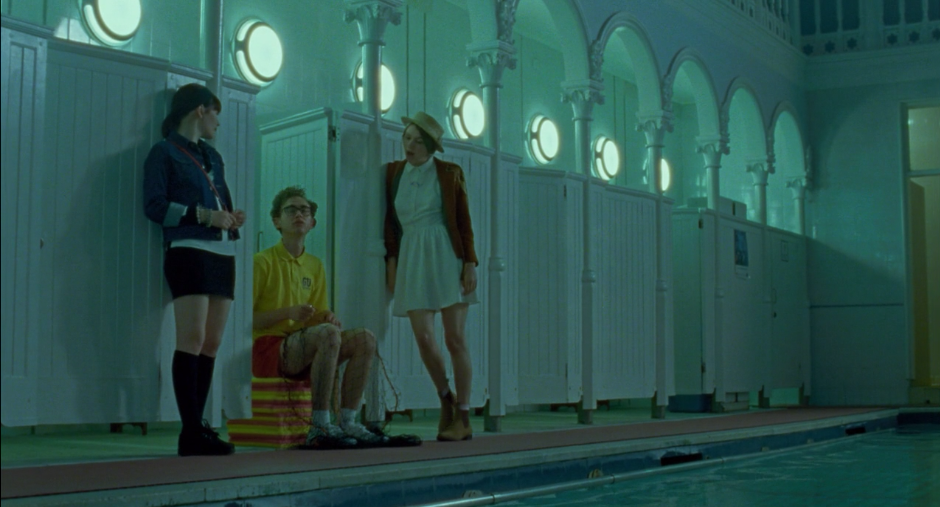


Together, these choices are baffling. On one hand, there is a drive for authenticity and "dispensing of the [polished] cool." Handheld shots, image quality, and location choices reflect a "sub-current" environment that is in rebellion (or rather, disengagement) with the conventional glamour and attractiveness. On the other, there is still an artistic style. There is a careful crafting of the image that suggests an attempt to define another form of beauty. It isn't so much a rejection of visual tastes so much the assertion of a specific alternative taste.

[Note to self: If image quality can't be pitch perfect, embrace it as part of the style and work other elements around (artistic grain ex); always get B-roll of extras, especially in dance scene; build costume colors off color elements already in scene, or vice versa.]
Subscribe to:
Posts (Atom)